Semi-trailer
CYP9402ZZX 40 t U-Dumping Semi-Trailer
- Handles
- 50 t payload
- Shipping volume
- 73.4 m³(calculated)
Semi-trailer · Semi-trailers
A frame, twist locks and nothing else. The lightest way to move a container, and the cheapest trailer we build to get to your port.
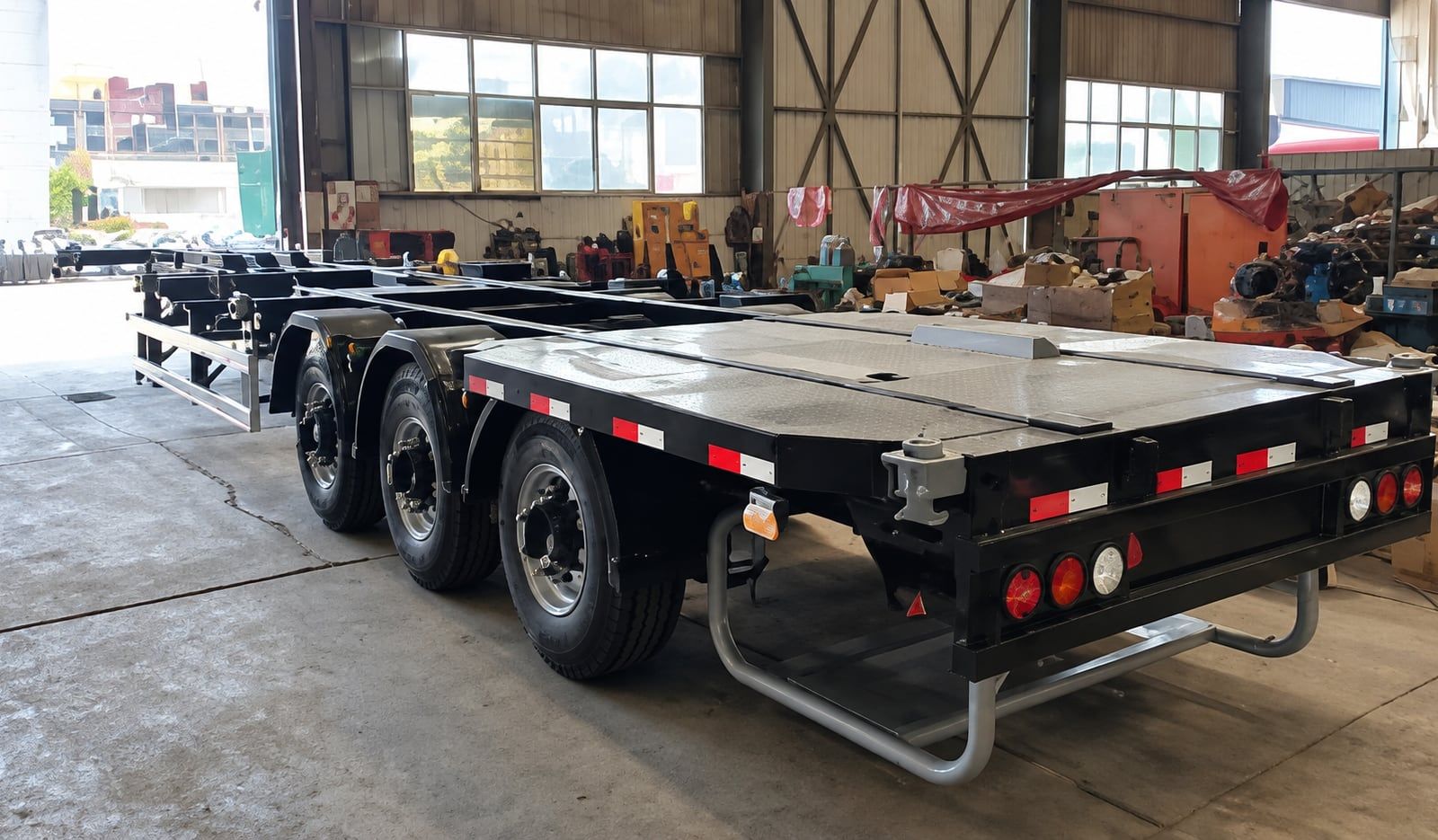
A skeletal container semi-trailer, manufactured in our own factory. It is a chassis with twist locks and nothing between them. No deck, no sides, no floor. The container is the body.
Length, axle count and axle brand are specified by you. So are the suspension, air or mechanical, on leaf springs or air bags; the king pin, 2 inch or 3.5 inch bolt-in; and the tyres and rims, from 11.00R20 through to 315/80R22.5 on 8.5-20, 9.0-20, 8.25-22.5 or 9.0-22.5, with steel rims optional. What we fix is the braking and the legs: a WABCO RE6 relay valve, T30/30 spring brake chambers, 40-litre air tanks, and JOST two-speed manual heavy-duty landing gear.
Container haulage, and only container haulage. Port to inland depot, depot to customer, and the empty leg back. If your business is boxes off a vessel, this is the trailer the business runs on, and most operators buy several.
It is tagged for haulage alone for that reason. There is no second job it can be put to on a slow week, and the specification is a straight answer to that: the buyer who needs a second job should be looking at the flatbed.
Our 12.5 m flatbed is built container compatible and it will carry the same box. Two numbers decide between them.
Weight. The flatbed is 6,500 kg unladen. A skeletal frame with no deck is lighter, and every kilogram of trailer is a kilogram of payload you cannot carry and a kilogram you tow empty on every return trip. Over a year of port runs that is fuel.
Shipping volume. A trailer with no deck and no sides encloses very little air, and sea freight is charged on the space a machine occupies rather than on what it weighs. This is the cheapest trailer we build to get to your port.
The flatbed wins the moment your loads are not all containers. If they are, the skeletal wins on both numbers that matter.
New build, out of our workshop, powder coated in your colour. The specification sheet is agreed in writing before any deposit and it is what the Proforma Invoice describes. Photographs come to you from the shop while it is being built.
One thing worth settling early: whether you want a fixed frame at one length or an extendable one. An extendable costs more, weighs more and handles both box sizes. If you move 40-foot boxes almost every day, a fixed 40-foot frame is lighter, simpler and has less to go wrong.
Shipping volume depends on the length you specify, so there is no single figure on this page and we are not going to invent one. What is certain is the shape of the answer: a frame with no deck and no walls is the smallest box on the vessel of anything in this catalogue, and it lands at your port for less than any other trailer we build.
Send us the specification and we will quote the volume and the freight to your port together. Loaded at our yard in Tangshan, shipped through Tianjin Port.
Which container sizes you move and in what proportion. Whether you want fixed or extendable. Your tyre size if you have a local supply, and your destination port and quantity. If you need prime movers as well, tell us how many, and we will price the whole set on one booking.
Because a container does not need one. It sits on the twist locks and carries its own floor. Every square metre of steel between the rails is weight you tow empty on the return leg and weight you pay duty on, so a skeletal leaves it out.
No, and that is the trade. A skeletal is a specialist. If you need one trailer that does containers some weeks and pallets others, buy the 12.5 m flatbed instead: it is container compatible and it has a deck.
Length, axle count and axle brand are yours to specify. The usual choices are a fixed 40-foot frame, a 20-foot frame, or an extendable that takes both. Tell us which boxes you actually move and how often, and we will tell you which one pays.
Mechanical or air suspension, leaf spring or air bag, a 2 inch or 3.5 inch bolt-in king pin, JOST two-speed manual heavy-duty landing gear, a WABCO RE6 relay valve with T30/30 spring brake chambers and 40-litre air tanks. Tyres from 11.00R20 through 315/80R22.5 on your choice of rim.
Only what the catalogue actually prints. A row that is not here is a figure we do not have yet. Ask, and we confirm it against the machine in our yard rather than guess at it.
Worth knowing
Dimensions, axle count and axle brand to order. Mechanical or air suspension · leaf spring or air bag · 2″ / 3.5″ bolt-in king pin · JOST two-speed manual heavy-duty landing gear · WABCO RE6 relay valve, T30/30 spring brake chambers, 40-litre air tanks. Tyres 11.00R20 · 12.00R20 · 11R22.5 · 12R22.5 · 315/80R22.5; rims 8.5-20 · 9.0-20 · 8.25-22.5 · 9.0-22.5, steel optional.
Semi-trailer
Semi-trailer
Semi-trailer